In 2025, Severin Borenstein posted Guess What Didn't Kill Rooftop Solar to the Energy Institute at Haas blog. In it, he argues that the California rooftop solar industry is quite healthy despite the implementation of the Net Billing Tariff (NBT/NEM 3.0), which drastically lowered compensation for rooftop solar exports. To support this, he presented a bar graph illustrating a 'market rebound' post-NBT, in which post-implementation sales (in green) seemingly dwarf those from prior periods (in red) across three different time intervals.
Just looking at that bar graph, one would be inclined to believe that rooftop solar sales barely skipped a beat, and in fact sales improved with NBT. However, the validity of this comparison hinges on its timing: the aggregates pivot around the NBT decision of December 2022, rather than the NBT implementation in April 2023. To see how this choice of before/after point affects the outcome, let’s plot the number of applications over time, with the time intervals Borenstein aggregates over superimposed.
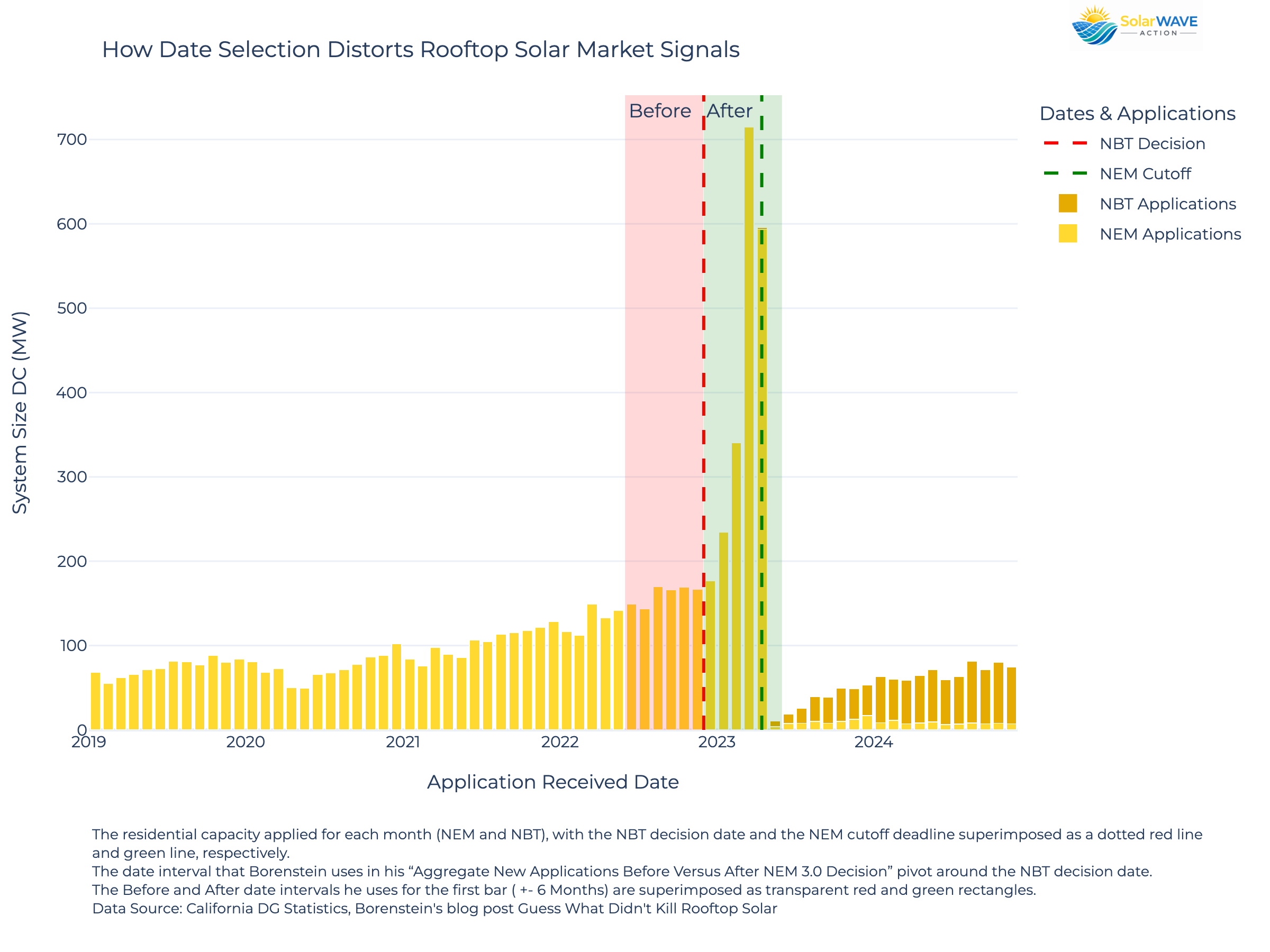
By superimposing one of Borenstein’s Before/After bars on top of actual residential capacity applications, it becomes clear why the NBT decision date is the wrong date for determining the effects of NBT; a vast majority of the “After” capacity in the bar is NEM applications submitted before the NEM cutoff deadline. The figure demonstrates that by including this highlighted area in his 'After' aggregate, Borenstein misrepresents the market’s health. This selection of data obscures, rather than reveals, the true post-NBT impact. If you’re truly concerned about sales being pulled forward by customers looking to beat the NBT deadline, a more honest way of assessing market impact would be to exclude the volatile time around the NBT application and decision and focus on applications a period of time before the NBT decision to a similar time interval after the NBT implementation.
"When we analyze data in ways that obscure volatility in the rooftop solar market, we undermine the very policies designed to meet our climate goals. "
Furthermore, Borenstein acknowledges the crash after the NEM cutoff deadline in April 2023, but he claims that “[...] market demand actually didn’t miss a beat. New system applications in the first seven months of 2024 were just 7% lower than in the same time period in 2019.” Borenstein’s choice of 2019 as a benchmark is questionable. It ignores the significant growth observed from 2020 through 2022—a period that clearly outperformed 2019 benchmarks. Claiming that the market during the 2020-22 time period was boosted due to rising electricity rates and fear of shutoffs are not grounds for removal — those are just two common sense reasons for why you’d want to install solar panels on your roof. Few businesses could credibly claim market stability based on sales figures that remain 7% lower than a half-decade-old benchmark.
Ultimately, the integrity of our energy transition depends on how we interpret the signals of our market. When we analyze data in ways that obscure volatility in the rooftop solar market, we undermine the very policies designed to meet our climate goals. At SolarWAVE Action, we believe that transparent, rigorous data analysis is essential to building a credible path forward for clean energy ownership. By holding industry narratives to a higher standard of evidence, we ensure that energy policy decisions are grounded in reality rather than convenient rhetoric.