Background
Imagine you own a small business in Santa Cruz. Your electricity bills have climbed 50% in five years, and you're finally ready to invest in rooftop solar — a system that can pay for itself in six years and then save you money over the rest of its lifetime.
Then you find out that before you can proceed, you must register your business with the state as a public works "awarding body," comply with prevailing wage laws, and take on liability for your contractor's labor compliance. And if your contractor makes a mistake, you could end up losing your solar billing rate.
Faced with added compliance costs, potential delays, and liability risk, you might feel overwhelmed and walk away.
This is exactly what happened across California in 2024. And it's exactly what Assembly Bill 1104 — signed into law in October 2025 — was designed to fix.
How a Well-Intentioned Law Hurt the Market
The issue stemmed from AB 2143, which took effect January 1, 2024. It required every business or multi-family property owner installing grid-connected solar to comply with full public works regulations — the same rules governing state agencies building bridges and courthouses. All of a sudden small businesses such as bakeries, retailers and animal shelters were treated as public construction agencies.
The results were severe; in Santa Cruz County, an estimated 11 to 15 commercial and industrial solar projects were delayed or abandoned in 2024 alone. To put that in perspective, there were typically 23 such applications per year historically.
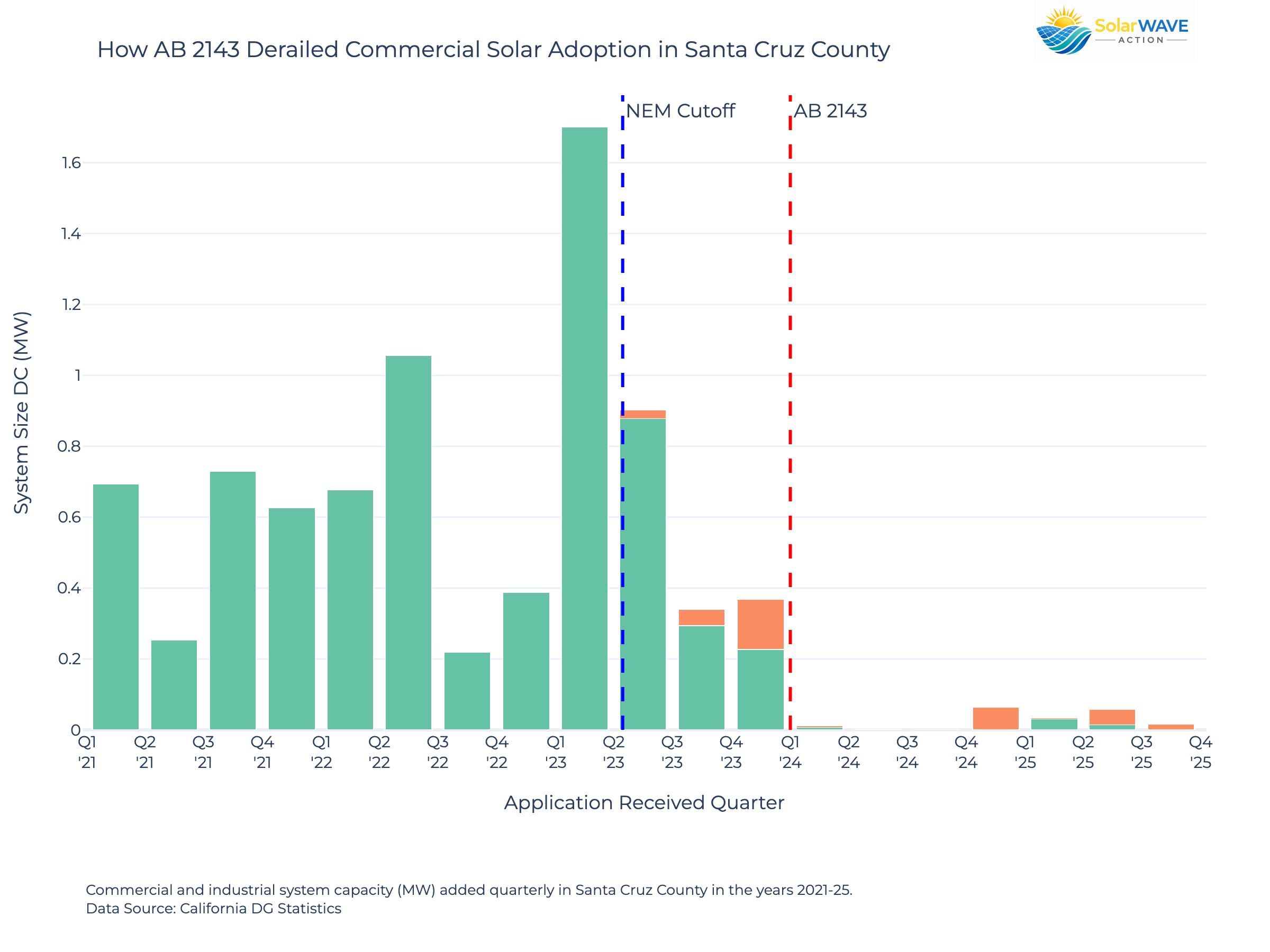
Compliance could add roughly $13,000 per project in consultant fees and administrative costs. Businesses also risked losing their Net Energy Metering (NEM) billing rate — worth approximately $7,200 per year in foregone savings for a median sized system — if their contractor committed any payroll violation. Add one to three months of project delays for the additional overhead, and the economics of solar stopped working out for the small businesses that needed it most.
The Lost Opportunity Cost
The underlying economics of installing commercial solar in Santa Cruz County remain favorable despite the transition to the Net Billing Tariff (NBT). A median-sized commercial system (~30 kW) generates about 45 MWh per year and delivers estimated net savings of $534,000 over 25 years, with a payback period of roughly six years and an internal rate of return of 19%. Even under conservative assumptions, payback happens within eight years.
This is a sound investment, especially considering that PG&E electricity rates have risen 8.5% per year over the past five years — nearly double the national rate of 4.8%. Every year a business delays going solar is a year of missed savings compounding against seemingly ever-rising utility bills.
The stifling conditions in 2024 translated directly into lost money for Santa Cruz County businesses: an estimated $193,000 to $263,000 in lost annual electricity savings from just one year of stalled projects. This is money that could have gone toward expansion or resilience.
What AB 1104 Actually Does
AB 1104 doesn't repeal worker protections. Solar contractors remain fully responsible for prevailing wages and labor compliance. What the law does is correct a fundamental misclassification: private businesses buying solar for their own use are not public agencies and are not "awarding bodies" under public works law.
"What the law does is correct a fundamental misclassification: private businesses buying solar for their own use are not public agencies and are not "awarding bodies" under public works law."
That single clarification eliminates the additional risk, time and cost that were killing solar installation deals for small businesses. More than two-thirds of Santa Cruz County commercial solar projects are 50 kW or smaller — precisely the segment burdened the most by AB 2143.
The Climate Stakes Are Growing
California is legally mandated to achieve 100% clean electricity by 2045, and commercial rooftop solar is a critical piece of that puzzle. Today, PG&E's grid is relatively clean, so each new solar installation provides modest near-term emissions reductions. But Diablo Canyon Nuclear Power Plant — currently supplying roughly 63% of PG&E's electricity — is scheduled to begin closing by 2030. Add that to increasing energy demand, it’s clear that we need to add as much low-carbon electricity as possible, including distributed rooftop solar.
Every commercial system installed now locks in clean electricity generation capacity that becomes more valuable as the grid transitions. Every year the market stagnates is a loss of momentum. AB 1104 isn't just good for small businesses — it's a necessary step toward the state meeting its own climate commitments.
The Bottom Line
A typical commercial solar installation in Santa Cruz County delivers an estimated $534,000 in net lifetime savings, pays for itself in roughly six years, and — thanks to AB 1104 — comes without the regulatory nightmare that derailed the market in 2024.
Commercial solar power is clearly a financial and environmental benefit. The real challenge, however, is whether we can move quickly enough to transition to clean energy before it's too late, and in doing so, boost the economy along with the climate.